Simone by Viet Thanh Nguyen explores complex themes such as displacement, environmental challenges, and intergenerational experience, making it a uniquely layered story for younger audiences. As the narrative connects generations and their emotional journeys, how did you approach conveying those cultural and emotional nuances through your narration? Additionally, did incorporating sound effects or character voices present any challenges in keeping the story engaging and accessible for young listeners?
The amazing thing about narrating children’s books is that they are illustrated! Fun fact: I have actually been a fan of the art of Minnie Phan, the illustrator of Simone, for over a decade. To tackle narrating Simone, I needed to hold the physical book in my hands to experience the story and the art. There’s a childlike magic that is woven throughout the book — even the handwritten text holds this quality — so I used this as my anchor to narrate the book. I love how deeply children love things, and how they learn and build hope; these are some of the qualities I wanted to make sure to hold to convey Simone’s emotional nuances. Meanwhile, to bring má’s character to life, I wanted to capture the twin qualities of calming resilience and bad-assery that I’ve experienced in countless women in my life. As a Vietnamese American who grew up in the bay area, this small and mighty book carries so many beloved cultural components to it. Má quoting Fred Hampton, is a great example of one of those. I mean, quoting a Black Panther to comfort your young daughter amidst a disaster…honestly, highly relatable. When it comes to character voices and sound effects, I think those are key to keeping books engaging for young listeners — it’s my favorite part when reading books to kiddos live! And there’s a lot of that in Simone, so I loved recording those, whether it was different children’s voices, the vrooms of the car, or the firefighters calling for evacuation.
My Vietnam, Your Vietnam: A Father Flees. A Daughter Returns. A Dual Memoir by Christina Vo and Nghia M. Vo presents interwoven father–daughter perspectives shaped by displacement, memory, and return. How did you prepare to narrate these two distinct yet connected voices? Did you rely primarily on the text or consult author notes and guidance before recording? Were there particular passages that resonated with you personally, and if so, how did that shape your performance?
When tackling the voices in any given book, my approach shifts based on the tone, voice, and style of writing. When it came to My Vietnam, Your Vietnam, while reading it, I could sense a longing and repression that bubbled underneath the surface of the text. I didn’t have to work as hard to find the two voices, because their voices were very clear in my head as I prepared, so I was able to just dive right in and keep going. Additionally, to narrate a memoir — or in this case, two memoirs — what I’m aiming to do is to tell the story in the voice of the author, rather than act out characters in dialogue. I did consult Christina in advance of the recording just on a few pronunciation bits. One crucial aspect of the book is not just Christina’s telling of her father’s silences, but an emotional distance present in his portions of the book. There is both pride and nostalgia, yet it is cloaked in this quality that is highly familiar for anyone who has relationships with Vietnamese men. I was surprised by how I would at times feel as though I was drowning in a constant hum of “đè nén” (suppression or repression). This certainly shaped my performance. I still remember — the day I finished recording the book, on my drive home from the studio, I was completely caught off guard when a wave of emotion just erupted from within me.
The Magic Fish by Trung Lê Nguyễn is a graphic novel that follows Tiến, a Vietnamese American boy who uses fairy tales to connect with his immigrant mother and to help express his identity. For the audiobook adaptation, you collaborated with another narrator and a full cast. How did your preparation differ knowing you would be part of a multi-narrator production rather than performing the story solo? Additionally, how do you approach dialogue scenes when you are recording without hearing the other narrator’s performance in real time?
Typically, when collaborating with a multi-narrator cast, we will consult with each other to ensure pronunciations and interpretations are aligned. In the case of The Magic Fish, the narrative structure of the graphic novel actually didn’t demand as much of this. In cases like this, I find that building understanding with the director is super valuable. To prepare for this project, I scheduled a call with the director, October Crifasi, in advance so that we could get on the same page for the characters as well as how we’d work together in the studio. October is a dream to work with, and especially for a project like this where ideally you have a director who is really well-organized but also imaginative and playful. In order to tackle those dialogue scenes where I didn’t have a sense of what the other narrator sounds like, I’d rely both on my imagination and also check with the director to make sure I was remaining within an appropriate ballpark.
Across the audiobooks you’ve narrated, is there a particular novel you would love to see adapted into a film or television series where you would especially want to be part of as a cast member? If so, which actors or creatives would you dream of collaborating with on that project? Additionally, how do you think your experience as an audiobook narrator would influence your approach to performing that story in a visual medium?
Sorry, but I’m going to give you multiple answers for this one! I would love to see My Father, the Panda Killer by Jamie Jo Hoang adapted into a film or television series. Unfortunately, I can’t play a 17 year old, and (protagonist) Jane’s mom is no longer in the picture, so there isn’t a role for me there! But nonetheless I’d love to see an adaptation. It’s a painful and poignant coming of age story and it really captures the heart of intergenerational trauma in a way that feels courageous and whole.
I’d be remiss to not mention my pipe dream of a film adaptation of The Mountains Sing by Nguyễn Phan Quế Mai, in which I’d love to play the character of Trần Diệu Lan. Diệu Lan is the character of the grandma, but because the novel jumps between different time periods, I would love to play her character in the 1950’s time frame of the story. I would love to collaborate with so many Vietnamese actors and creatives for this, and the best part is it would demand it! It’d be really cool to collaborate with Elyse Dinh and VyVy Nguyen, both of whom I’ve narrated with on multiple projects, on a grand film project like this. I’m also dying to collaborate with an actor friend named Alan Boell who could play any of the non-Vietnamese military roles brilliantly (he is a former Marine), but he’d also be amazing as Wicked Ghost.
To me, narrating a book is actually incredibly similar to the imagination and history prep work required for rich acting performances. The major difference here is that you have authors who have lived in these worlds and drawn them out vividly to support you in that prep work.
I say that it is a pipe dream, but I also believe that adapting the Mountains Sing would be extremely important anti-war work, not just for Hollywood and Entertainment. As I answer these questions, the US, alongside Israel, just bombed Iran in yet another horrific cycle of violence. Narrating works about war and its aftermath has deepened my commitment to fighting for a world that isn’t run by man-children bombing each other in a race for power. Art can help us internalize how unbearably stupid and cruel war is.

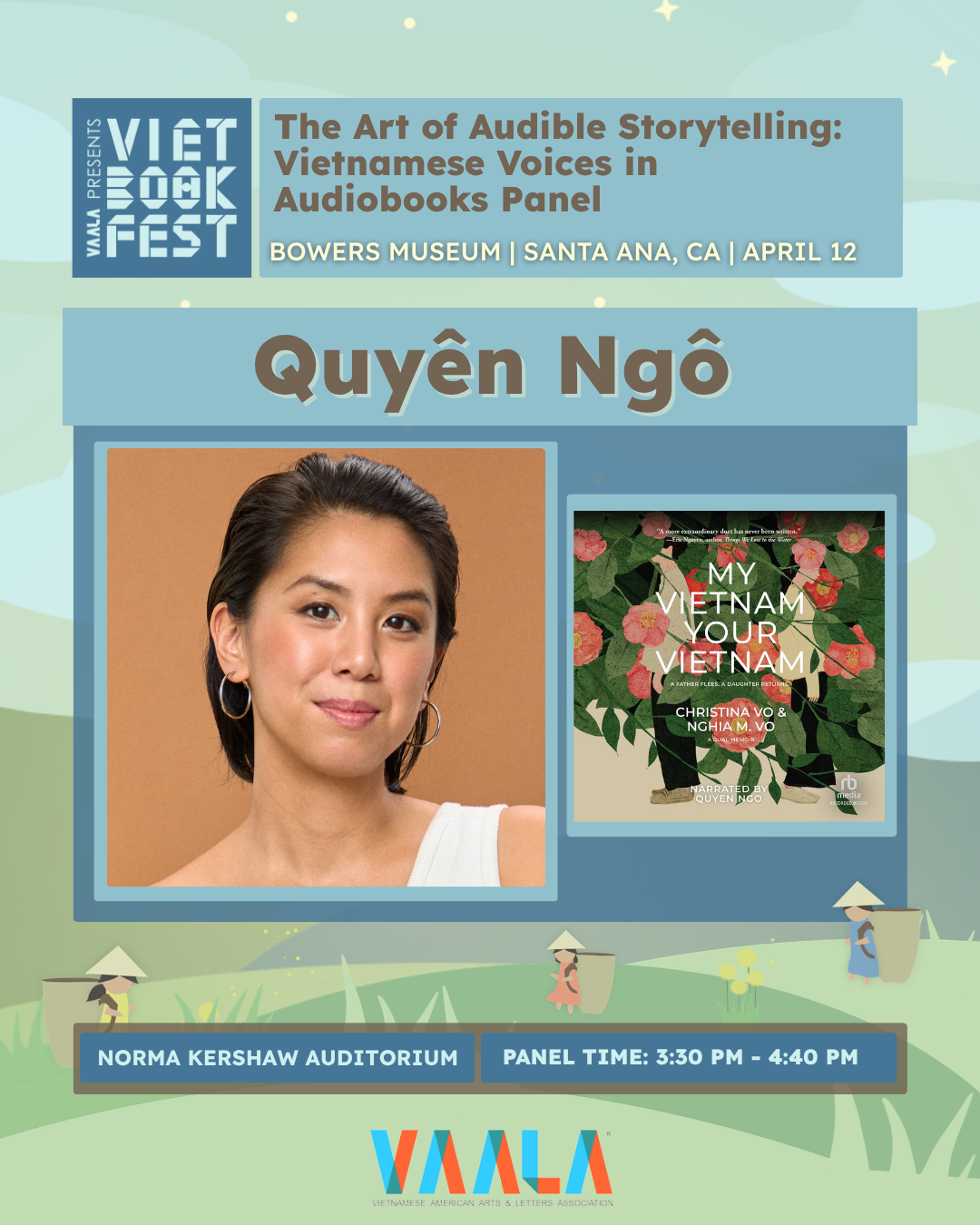
Quyên Ngô is an actor, facilitator, and trainer based in Los Angeles. She is an Audie-nominated and Earphones Award winning audiobook narrator of titles such as Things We Lost to the Water by Eric Nguyen, The Colors of April, an anthology of fiction by Vietnamese writers, The Mountains Sing by Nguyễn Phan Quế Mai, and most recently, Discipline by Larissa Pham. She is the co-founder of VìTÂM, a nonprofit organization dedicated to creating resources and spaces for difficult dialogue in Vietnamese communities — across generations and demographics. She formerly worked as a news anchor and soul and funk dj on the radio. She is a translator of Vietnamese prose and poetry and believes that translation is a sacred art.
This interview was conducted by Alan Trinh, Viet Book Fest’s Program Manager, as part of the Author Spotlight series. All featured authors participated in Viet Book Fest 2026, a literary event presented by the Vietnamese American Arts and Letters Association (VAALA).
Join us on Sunday, April 12, 2026, from 10 AM to 5 PM at the Bowers Museum in Santa Ana, California for a full day honoring Vietnamese storytelling and culture in literature.
Viet Book Fest 2026 offers a full day of programming focused on Vietnamese literature, storytelling, and culture. Attendees can participate in five panel discussions, enjoy interactive activities for children, and experience youth performances that showcase Vietnamese traditions and creativity. The festival also provides a space for community collaborations, where participants can create their own art and engage in hands-on projects.