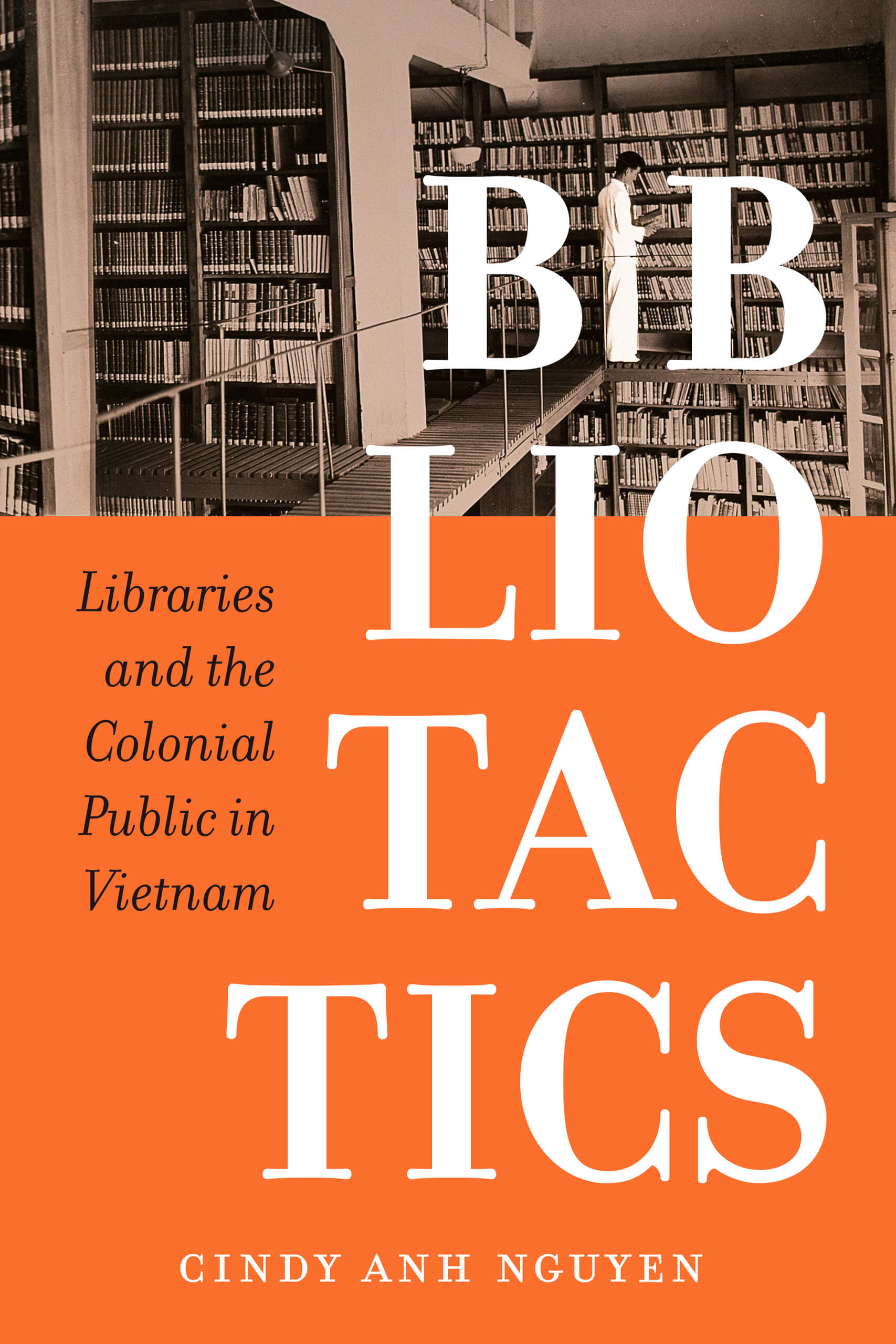
In her forthcoming book, “Bibliotactics: Libraries and the Colonial Public in Vietnam” (UC Press, 2026), Cindy Anh Nguyen reveals the little-known history of how libraries in early 20th Century Vietnam served as governmental institutions that enforced colonial dominance yet provided a forum for Vietnamese intellectualism and public life.
Nguyen, an assistant professor of Information Studies with appointments in the Digital Humanities Program and Asian Languages & Culture. She uses transdisciplinary research to examine historical and socio-technical production of knowledge in Southeast Asia through libraries, encyclopedia, visual media, and language through feminist, decolonial, and critical approaches.
Her work has appeared in the Journal of Vietnamese Studies; Verge: Studies in Global Asia; the Journal of Interactive Technology and Pedagogy; the Vietnamese American Refugee Experience Model Curriculum; and in numerous edited volumes on history and digital humanities. Nguyen is the recipient of a 2025 National Endowment for the Humanities Research Fellowship in Cambodia from the Council of American Overseas Research Centers; a Chancellor’s Arts Initiative Grant from UCLA (2024); the University of California Chancellor’s Postdoctoral Fellowship (2021); and the Phyllis Dain Library History award from the American Library Association (2021).
This summer, Nguyen organized a transnational library workshop for leading cultural heritage institutions in Cambodia titled, “Empowering Cambodian Libraries: Building Sustainable Digital Futures,” held at the Center for Khmer Studies in Siem Reap. Nguyen earned her PhD in history at UC Berkeley, her master’s degree in history at Michigan State University, and her bachelor’s degree in history and Southeast Asian studies at UCLA. Nguyen is also a public scholar and community artist whose work can be viewed on her website.
To see her multimedia book website, such as recordings, zines, and teaching materials to accompany Bibliotactics, see the website https://bibliotactics.com/
Book Excerpt: “This book approaches the history of the library as institution and practice. Libraries are material repositories reflecting collecting regimes of librarians, contemporary definitions of “books of value,” and state visions of national heritage, as well as the global and local book market at certain historical and political moments. Everyday library operations reflect changing technical, cultural, and social practices around book preservation, public reading, and demands for certain types of reading matter for educational, leisure, and professional purposes. Libraries are part of a complex ecosystem of intentional and unintentional book circulation shaped by politics, culture, economics, technology, and logistical randomness. Distinct from publishing houses and bookshops, libraries play an important role in secondary distribution, reflecting the movement of text to unintended audiences not anticipated by author or publisher. Libraries carry deep cultural meanings. As an assemblage of book objects of knowledge and narrative, libraries connect individuals to imagined communities of reading and ideas. Libraries perform prestige and scholastic identity, and as spaces for intellectual inquiry and the pursuit of curiosities. Libraries are gathering spaces of humans and knowledge, architectural feats of state infrastructure. Libraries carry tremendous social and cultural capital as battlegrounds for the definition of the public. The value of libraries was a centerpiece of critique by intellectuals, statesmen, readers, librarians, activists, and revolutionaries throughout the colonial and postcolonial periods. Builders and users debated whom should the library serve, the immediate public with specific language, literary, and intellectual needs or the imagined public of the future?” (Nguyen 11)
Q&A
Question: Bibliotactics presents the history of libraries in colonial Vietnam, and one thing you discuss is the libraries’ roles in Vietnamese reading culture and creating a Vietnamese literary heritage. As you were doing all this research, did you feel that you were able to trace or claim your literary heritage, as a Vietnamese American academic? On a more personal level, were you able to see your ancestors in the colonial archive, or how could you locate them despite their absence? I’m thinking about your beautiful paragraph in your book’s Acknowledgements where you write, “This book had its true beginnings with my parents and ancestors, who proudly come from at least two generations without formal lettered training. Their education came from survival, creative entrepreneurship, and commitments to community and spiritual practice throughout times of hardship, war, and displacement.” In your interview with Jen Hoyer, you shared that your father frequently went to the library in Saigon in the 1980s because it was a busy place for him to sell things and make money. I am wondering what you and your family consider to be your literary heritage – or simply, what are their relationships to libraries and reading, and reaction to your research topic?
Cindy Anh Nguyen: I realized, somehow late in my academic life and writing this book that I actually come from at least two generations (now confirmed by my mom, three generations) of those without ‘formal learning’. Rather than as a ‘literary’ and ‘intellectual’ family our concerns were about survival, community, and connection. This positionality informed how I first understood and wrote about Vietnamese reading culture and library history firstly as an outsider—so I wrote about library history as one of power, privilege, hierarchy, patriarchy. All of those elements are woven into the book when discussing the racial hierarchies, elitism, gendered and paternalistic dimensions of reading and library access within the hegemonic constraints of French colonialism as well as nation-state efforts.
One could say, my family does not have a ‘literary heritage’ in a traditional sense. We were not bookish– my parents, grandparents, and great grandparents were not formally educated through schooling. My mom tells me that she cannot remember ever seeing my grandmother read anything, ever, besides maybe prayer pamphlets but she recites by heart. Yet it was through the realization that I come not from a capital Literary background, I shifted my framing that this book too, was about everything ‘around’ the book—the people, the social interactions, the misreading and defiance, the space, the visions, dreams, and cultural identity associated with building library collections in the past and present.
Question: In addition to being a professor and scholar, you are also a multimedia community artist. I was listening to your interview with Jen Hoyer, you shared how during your research for Bibliotactics, you were also essentially writing an anti-book to try to process things, like writing historical fiction from the perspective of a 25-year-old university graduate biking to the library. I’m wondering if you feel there is a relationship between your scholarly work and your artistic projects, such as to further explore or to assemble all the interesting things you stumble upon in research through artistic mediums. I also imagine that being a scholar of Vietnamese studies sets you up for lifelong identity work. How have your interests and questions and sense of self, in academia and the creative arts, evolved over time?
Cindy Anh Nguyen:
My mom’s commentary about my grandmother’s reading habits also opened up new approaches to thinking about literacy not as a black and white state of existence, but as a situated social practice in community. Literacy, biết chữ–biết đọc biết viết—[knowing letters, knowing to read, knowing to write] had specific social, personal, political purposes. For my parents and grandparents, learning and knowing English was about survival as new refugees in the late 1980s. Their English literacy was a social one, that brought in me and my siblings who went through formal American public schooling and functioned as everyday interpreters, translators, dictators, transcribers of tax forms, government documents, neighbor disputes, and employment applications.
My research journey for the book throughout undergraduate, graduate school, field work in Vietnam, postdoctoral and now professorship stages of writing was interwoven with these artistic, lifelong processes of self-understanding and familial narrative. I’ve written creative essays and made film on love, language and loss. “The Slow Undoing of Velcro Shoes” was originally written while I was doing dissertation fieldwork in Vietnam, navigating what it meant to be a Vietnamese American historian living and working in contemporary Vietnam. I was navigating my own literacy and fluency in Vietnamese while living in Hanoi and Saigon. My Vietnamese language comprises a patchwork of immigrant southern 1970s Vietnamese vocabulary, 1990s Little Saigon Viet-lish, meshed together with academic Hanoi Vietnamese that I learned through Ph.D. schooling to become a historian and recent Saigon youth slang. In “The Slow Undoing of Velcro Shoes” and the film essay “Velcro Shoes” I mourned the loss of my childhood Vietnamese when it was displaced by English through haunting moments of shame and American public school assimilation. I write about the ways in which Vietnamese of my younger years then became a secret, language of family and home, and not a language of expression but of misunderstanding, resentment, mistranslation, and unspoken emotions between my family members navigating a bilingual household. My film and essay “The Undeniable Force of Khó Khăn” was an attempt to move away from the bittersweet mourning of language loss, to an invitation into translation as a process of connection, empowerment, nonlinear meaning making that I navigated with my mom over the years.
Drawing back to my academic work for Bibliotactics, my process of historical sensemaking was interwoven with an artistic collaging of meaning, as you had noted in my critical fabulations of fragments of past historical actors. Both my academic and artistic work is textured by a slow meditation on words, sensations, contexts, an intellectual compassion that moves me to understand the past–from strangers to myself and my family.
Question: Working on any long-term research project rarely goes exactly as planned. Were there serendipitous discoveries, encounters, or conversations that made you revise what you originally thought Bibliotactics would be about?
Bibliotactics is a book about books, but also everything around the book. For me, this shift was a key moment in the research and writing process to shed light on the history of Vietnamese libraries and reading culture from 1917 to 1958. I drew inspiration from feminist and postcolonial scholars to write boldly and defiantly about the power and politics of reading. I unearth library systems of French cultural propaganda and Vietnamese 1930s debates of ‘proper’ reading habits rooted in patriarchal urban elitism. Yet I also uncover moments of agency and self-empowerment through the formation of women reading circles and self-directed education within the library stacks. I initially wanted a simple story, but I ended up with one all about contradiction, where the library purported access and self-determination within the constraints of colonial racism and nation-state efforts. By recentering on specific practices, the book then isn’t really about just libraries, but about community practices of building identity, learning, and heritage across time and space–to document, to be in public, to circulate, to read, and to reassemble.
“The library is more than an institution, an infrastructure of knowledge and hegemony. It is a set of social practices, technical approaches to preservation and communication, and a platform for debate regarding national heritage and the envisioned public of the present and future.” (Nguyen 2021)
“Bibliotactics: Libraries and the Colonial Public in Vietnam” is available free open access as well as print copies through UC Press.

Cindy Anh Nguyen is Assistant Professor at the University of California, Los Angeles with appointments in Information Studies, Digital Humanities Program, and Asian Languages & Culture. Nguyen bridges academia and the public through her multimedia arts practice, public curriculum and digital humanities pedagogy, and community platforms. Her work has appeared in Journal of Vietnamese Studies, Verge: Studies in Global Asia, Journal of Interactive Technology and Pedagogy, the Vietnamese American Refugee Experience Model Curriculum, Wasafiri, Ajar Press, Diacritics, and exhibitions such as “Textures of Remembrance: Vietnamese Artists and Writers Reflect on the Vietnamese Diaspora”. She is the cofounder of Troubling Narratives, a global digital public research collective committed to work through the methods and ethics of Southeast Asian studies through feminist and decolonial practices.
This interview was conducted by Cathy Duong as part of the Author Spotlight series. All featured authors participated in Viet Book Fest 2026, a literary event presented by the Vietnamese American Arts and Letters Association (VAALA).
Join us on Sunday, April 12, 2026, from 10 AM to 5 PM at the Bowers Museum in Santa Ana, California for a full day honoring Vietnamese storytelling and culture in literature.
Viet Book Fest 2026 offers a full day of programming focused on Vietnamese literature, storytelling, and culture. Attendees can participate in five panel discussions, enjoy interactive activities for children, and experience youth performances that showcase Vietnamese traditions and creativity. The festival also provides a space for community collaborations, where participants can create their own art and engage in hands-on projects.